How Long Does Electrolysis Take to Work? [Timeline & FAQs]
![How Long Does Electrolysis Take to Work? [Timeline & FAQs]](https://www.laserbyaleya.com/wp-content/uploads/2014/04/how-long-does-electrolysis-take-to-work-hero-image.png)
How Long Does Electrolysis Take to Work? Key Takeaways
- There’s no exact timeline for when electrolysis will start working, as it depends on factors like your hormones and ethnic background
- A trained electrologist treats one follicle at a time, making it an ideal option for anyone, regardless of skin or hair color
- After your electrolysis hair removal session, you might notice some shedding, which is completely normal
The hair removal industry isn’t slowing down. In fact, it’s growing fast, jumping from $4.91 billion in 2025 to $5.42 billion in 2026.
Clearly, more people than ever are looking for long-term solutions, but here’s the thing.
While it’s pretty easy to ballpark how long laser hair removal might take, electrolysis is a bit trickier, especially when you’re wondering “how long does electrolysis take to work?”
Electrolysis is a hair removal process that works one follicle at a time and depends on your hair’s natural growth cycle, meaning results don’t happen overnight.
If you want to know how long it’ll take to see real progress, you’re in the right place since we’ve got the answers.
In this guide, we will:
- Walk you through how long does electrolysis take to work, including what factors can speed things up (or slow them down)
- Share how many sessions you’ll likely need for each body area
- Cover what you should expect after your electrolysis hair removal session
How Long Does Electrolysis Take to Work? What Really Affects Your Results
Electrolysis is permanent, but results don’t happen overnight. If you’re asking, “How long does it take to work?” the honest answer is: it depends.
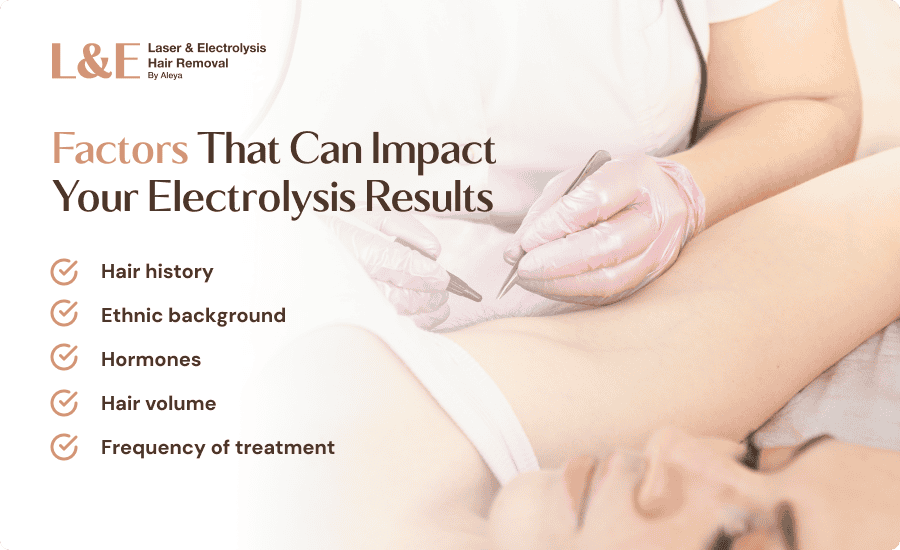
Electrolysis is the only FDA-approved method for permanent hair removal, but how fast you see results depends on a few important factors, including:
1. Hair History
Think of your hair like a muscle. The more you work it out, by shaving, tweezing, or threading, the stronger and more stubborn it becomes.
So, if you’ve been tweezing those chin hairs for years, they’ve likely grown deep roots and will take longer to treat.
Waxing is a bit gentler since it pulls the hair from the root, but over time, it can still make the hair grow back thicker.
Either way, your past hair removal habits play a key role in how long electrolysis will take to fully destroy the follicles.
2. Ethnic Background
Like it or not, your genes play a big role in how your hair grows and in how long electrolysis takes to work for you personally.
If you’re Middle Eastern, Indian, Italian, or Greek, you probably have thicker, coarser hair, and lots of it.
That just means it might take a few more sessions to fully treat but rest assured; electrolysis still works beautifully.
On the other hand, if you’re Asian, Polish, French, or from many parts of Europe, your hair might be finer and less dense, which typically requires fewer sessions.
3. Hormones
If you’re dealing with PCOS or going through a hormonal shift, like puberty, pregnancy, or menopause, you might notice new, coarse hairs popping up in places you didn’t exactly sign up for.
These hormonally driven hairs tend to be thick, stubborn, and sneaky, but yes, electrolysis can treat them.
It just might take a bit longer, especially if new hairs keep appearing as hormone levels change.
4. Hair Volume
This one’s pretty straightforward: the more hair you have, the more time you’ll need.
Electrolysis treats one hair at a time, so the size of the area (and how much hair is actively growing there) is a major factor in how long it takes to reach permanent results.
5. Frequency of Treatment
When it comes to electrolysis, timing plays a bigger role than most people realize, especially if you’re asking how long does electrolysis take to work and when you’ll start seeing results.
It works best when your hair is in its early growth stage, called the anagen phase, which is when the follicle is most vulnerable and easiest to destroy.
To catch as many hair strands in this stage as possible, your electrologist will likely recommend weekly or biweekly sessions at first.
If you show up consistently, you’ll see steady progress.
But if you come in sporadically, say, once every few months, you’ll still see results, but it will take much longer.
How Many Electrolysis Sessions Do You Need? Estimated Sessions by Body Area
How long does electrolysis take to work for different areas of the body?
Here’s a helpful breakdown by body area to give you a clearer picture of what to expect.
| Body Area | How Long Does Electrolysis Take to Work? | Why It Varies |
| Upper Lip | 10–20 | Small area, but hair grows in multiple cycles |
| Chin | 15–30 | Often coarse and hormone-related |
| Eyebrows | 8–15 | Requires precision shaping |
| Underarms | 15–25 | Moderate density, responds well to consistent care |
| Bikini Line | 20–35 | Coarse, dense, and hormonally influenced |
| Full Legs | 40–60+ | Large area with many follicles |
| Arms | 20–40 | Medium-to-large area, usually finer hair |
| Back/Chest | 30–60+ | Dense growth, especially in men |
| Stomach | 15–30 | Hormonal hair growth is common |
What To Expect After Each Electrolysis Session
If you’re expecting to walk out of your first appointment totally smooth and hair-free; let’s set the record straight, permanent results take time.
If you’ve been asking “how long does electrolysis take to work”, the answer depends on consistency, hair cycles, and patience.
Here’s what you can expect after each session:
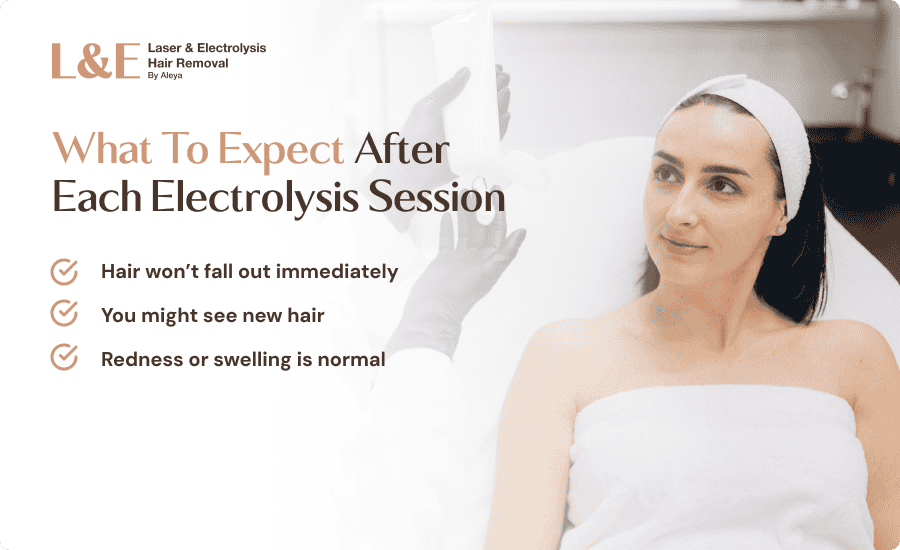
1. Hair Won’t Fall Out Immediately
Don’t be surprised if the hair is still there when you leave your appointment.
Electrolysis works by destroying the hair follicle at the root, not yanking the hair out.
That treated hair will shed naturally over the next few days to a week.
No need to tweeze, just let your body do its thing!
2. You Might See New Hair
It’s easy to think the treatment didn’t work if new hairs pop up, but what you’re seeing isn’t the same hair growing back.
Hair grows in cycles, and electrolysis can only treat the ones in their active phase.
So those new hair strands? They’re just the next batch waiting for their turn.
3. Redness or Swelling Is Totally Normal
After a session, it’s common to notice some side effects, like redness, slight swelling, or a warm, flushed feeling, especially if you’re treating sensitive spots like the face or bikini line.
On the bright side, it usually fades within a few hours.
To help calm the area and speed up healing, try applying aloe vera or witch hazel, they’re gentle, soothing, and do wonders for post-treatment skin.
Find Electrolysis Hair Removal Services at Laser by Aleya
No two people respond to treatment the exact same way, which is why “how long does electrolysis take to work” can vary from person to person.
But one thing’s for sure: if you stay consistent, you will see results.
At Laser by Aleya, every electrolysis session is customized to your unique blend of skin tone, hair texture, and sensitivity, because real, lasting results don’t come from one-size-fits-all treatments.
Aleya uses the Apilus XCell, one of the most advanced electrolysis systems out there, known for its precision and extra-gentle touch.
In simpler terms, you get faster results with less discomfort and more peace of mind.
How Long Does Electrolysis Take to Work? FAQs
What is electrolysis hair removal?
Electrolysis is the only method that’s FDA-approved for truly permanent hair removal.
It works by using a super-fine probe to send a tiny burst of electric current into each hair follicle, stopping future growth right at the root.
How long does electrolysis take to work before you start seeing results?
Most people start noticing visible improvement within the first few sessions, especially when treatments are done consistently.
How many sessions of electrolysis do I need?
Most people need between eight and 20 sessions to fully clear an area, depending on the size, hair density, and how consistent you are with treatments.
How many electrolysis sessions for the chin do I need to see results?
You’ll likely need 15 to 30 sessions to fully clear the area, but you may start seeing visible improvements within the first five to eight treatments if you’re consistent.
The chin is often influenced by hormones, which means the hairs there tend to be coarse and persistent.
How long does electrolysis take to remove facial hair?
If you’re wondering how long electrolysis takes for facial hair, most people need regular treatments over eight to 12 sessions to achieve permanent results.
How many electrolysis sessions for the face do I need?
Facial hair varies a lot from person to person.
For areas like the upper lip, sideburns, or jawline, expect around 12 to 25 sessions for permanent removal.